
John Aloysius Stanaway was born 21 June 1881 in Helensville and was the ninth child of Henry and Rose Stanaway (Birth Certificate Number 1881/1988).

“Jack” 1902 in London for coronation – Vince Stanaway Family Collection
We have no records of his early life but we could expect that it was much the same as his siblings and that of other children at that time in the area.
On 11 March 1902 John, at the age of 22 years and 9 months, signed up with the Ninth Contingent for Service in South Africa – The Boer War. His Regimental number was 7849, Trooper, South Island Regiment – D Squadron.
From his war records we see that he joined up in Dunedin, he was in Dunedin with his older brother Henry, his occupation was listed as a carter and his brother was listed as next of kin.
From family accounts apparently he marched with the troops with his hat pulled down so he wouldn’t be recognised and reported as being under age. There is some discrepancy as to his age in his War Records.
At the end of the Boer War the New Zealand Government was asked to send a contingent of soldiers to England for the coronation of Edward VII. Young, unmarried and tall John was selected to be part of this contingent.
Arriving in England he was billeted at Aldershot (still a large military base today). The coronation was delayed as Edward VII developed appendicitis. In the meantime he did guard duty at St. James Palace. – Vincent Paul Stanaway
We are fortunate to have, curtesy of the Vince Stanaway Family Collection, two letters Jack sent to his sister Isabel (Bell) addressed to the grocery and general store “Stuart Bros” in Helensville which give some in site that firstly that it appears he did not tell anyone he was enlisting, and what he was up too……
Cape Town May13th
My Dear Bell,
I suppose you got a bit of a shock when you heard I went away in the ninth contingent. We had a lovely trip across the going from New Zealand to Durban in thirty three days.
We called at Albany and stayed there two days. We had a lovely trip across the Indian Ocean it was as calm as a mill pond and had concerts two and three times a week. When we reached Durban we had to anchor out for 4 days as there was not enough water on the bar to allow us in. There were 4 transports with troops and twenty three steamers all waiting to get in and we had to wait our turn.
We encamped in Durban 2 days and then entrained for New Castle. Durban is a very pretty about the size of Auckland but more than half its population are blacks. We were three days and nights in open trucks going from Durban to New Castle. We stopped at Colenso Glencoe and Lady Smith and saw the places where a lot of the big battles were fought.
We stayed at New Castle eight days and then continued on as far as Elandsfontein. The seventh contingent were in camp there waiting for us to relieve them. I went to my duty in New Castle the priest got leave granted to all the Catholic’s to go to eight o’clock mass and to vespers at night. When we were in camp at Elandsfontein orders came to pick out twenty men to go Home to the coronation & I was one of the twenty he picked.
We left Elandsfontein last Thursday & had another 5 days in the train to here. We are now waiting for the tenth & Seddon and expect to sail about the 24th. It is very hot in the day time here and would freeze you at night. We get 20 pounds each when we leave Cape Town, and our pay stops from when we leave Africa till we arrive back again.
There are plenty of snakes here, one of the boy in the same tent as me got one in his blankets when he was going to bed. Things are terrible deer here you have to pay 5 & 6 shillings for anything like a decent meal. Now I think I have told you all worth telling so will close with love to all from your loving brother Jack
P.S. I will write again from London
The second letter he writes from London
Alexandra Palace
July 16th 1902
My Dear Bell,
I suppose you are thinking it about time for me to write, but better late than never. We had a lovely trip from South Africa going from Cape Town to ……….. in 18 days. We called at Maderia and were allowed ashore for 5 hours. The boat we came in is the largest steamer running out of Africa, we had 973 passengers and had sports nearly every day besides fancy dress balls and concerts at night. It was terrible hot crossing the line, we only wore a pair of trousers and a shirt, and slept on deck with nothing over us. We came from Southampton to here in the train and there were thousands of people waiting at the station to see us arrive. There are about 1500 Colonials here, and we can go to anything we like free of charge, every morning there is a list of places, opera’s fete put on a board & those wishing to go, to the different things just get a pass to what ever they want to go to.
I was down at the Colonial Club the other day with some of my mates, and Lord Carrington came in and asked us if we were New Zealanders and we said yes, and he put us in a cab & brought us down to the House of Commons and the House of Lords, while parliament was sitting, then he took us out on the terrace and introduced us to Chamberlin Lady Brassey and about a dozen more. The dress of the ladys there was something grand. You ought to see the trains they have to there skirts they are about 4 or 5 yards long. I cannot explain to you what London is like on paper for it would take me a week to write it down. We have thousands of people visiting us every day and on Saturdays & Sundays there is never less than 10,000 people in the grounds. We are going to wait here for the Coronation but the date is not fixed for when it is going to be.
……. Page(s) missing.
John was discharged after 240 days service. He received the South Africa 1902 clasp.
The next record we have of John is in 1909, where according to Archives NZ he is working as a “Locker” then by 1910 and until 1915 as a “Tide Waiter” in Wellington. These are what we would now call NZ Customs – he would board ships and watch the loading and unloading goods, inspecting what has or has not been declared, rewards were issued to these workers if goods were found that had not been declared.
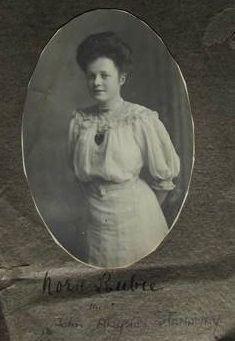
Elizabeth Nora Rubie – Vince Stanaway Collection
In 1911 John marries Elizabeth Nora Rubie (Marriage Certificate Number 1911/3165). Elizabeth was born 22 September 1885 in Delhi, India.
Nora was the youngest of 2 children of Philip Charles and Eleanor Rubie. Her father died in Madras, while Eleanor and the children lived in England at that time. After her father’s death her mother decided to move to New Zealand, Nora was about 15 years old when they arrived in New Zealand. Nora had been involved in two shipwrecks, the first was on the vessel Clan MacGregor on her way back to England, and then on her voyage to New Zealand the Ruapehu ran aground on Farewell Spit on New Years Eve 1900. Nora was very musical.
By 1918 John and Nora have moved back to Helensville with their three young children – Philip John (1912), Mary (Molly) Patricia (1915) and Vincent (Military Medal WWII) (1918).
Vincent was given no middle name because his parents didn’t get him christened as they were in Auckland at the time of the Spanish flu was about and would not risk taking him out – Vincent Paul Stanaway.
John went to work for his brother-in-law, Wilfred Allen.
The 1919 Electoral Roll has John living in Helensville and listed as a Grocer. The following Electoral Rolls in 1928, 1935, 1938 and 1946 all have John living in Helensville and listed as a Store Keeper (grocers).
John and Nora started a grocery store next to the Star theatre in 1925.
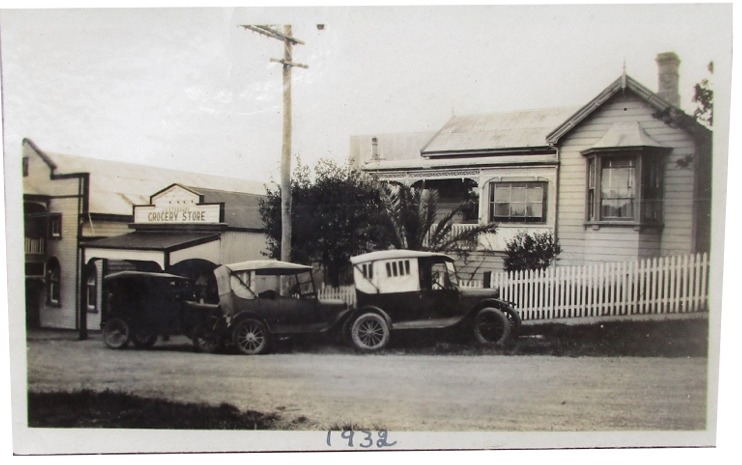
The Star Theatre, J A Stanaway Grocer and Becrofts residence – Vince Stanaway Collection.
From Men Came Voyaging in Chapter 17 – page 216 we read;
The store after the fire – Vince Stanaway Collection
The Star Theatre which had seen the beginning of the Secondary Department of the Helensville District High School was razed in a fire which also consumed Mr. Jack Stanaway’s nearby grocery store around 4 a.m. on 21st September 1933…… The Star Theatre, the property of the A.O.F. Lodge, erected by Henry Stanaway for $357 on a site donated by Daniel Stewart in 1884, was never rebuilt…… Mr. J. Stanaway reopened his grocery business in Megson’s original store across the road and nearer the Awaroa River.
Mr Stanaway had scarcely begun trade in his new store when Stewart Bros. sixty year old premises on the opposite side of Commercial Road were completely gutted by flames.
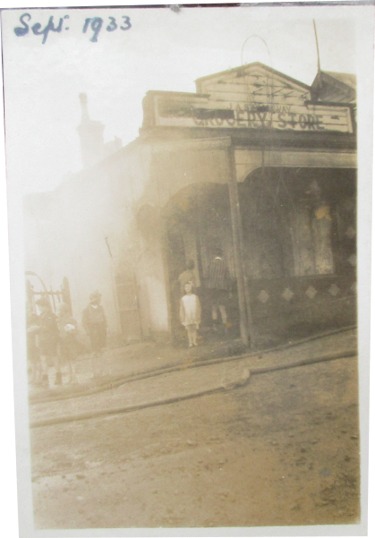
They opened another store on the corner of Green Lane and Garfield Road in 1933, but were burnt out again in 1944. They then opened a small shop on the corner of the Regent Theatre – to keep the business until Vincent returned from WWII.
From Men Came Voyaging in Chapter 18 – page 228 we read;
Another severance with Helensville’s past was caused by a fire in April, 1944, which completely removed all traces of the old store by Awaroa bridge, originally owned in the 1880’s by Joseph Megson and at the time of the fire, owned by Mr. Jack Stanaway, grocer. The hairdresser’s business which adjoined this store was also destroyed by the flames. Mr. Jack Stanaway, who had lost his previous grocery store by fire, was again a heavy loser, but undaunted, he set up a new grocery in the corner shop of the “Regent Theatre”. Later, Vincent Stanaway succeeded his father in this store and in 1949, this business was sold to R.J.Pickering.
From Men Came Voyaging in Chapter 18 – page 226 we read;
As Chairman of the Helensville Town Board, the welcoming speeches at these functions were made by Mr. Jack Stanaway, the only man known to have left from Helensville to fight in the Boer War and the father of a young soldier, Vincent Stanaway.
He was a member of the Helensville Town Board from 1938 – 1946 and chairman of the board from 1941-1944.

Gave site – Helensville Cemetery – Vince Stanaway Collection
John passes away 1 October 1946, in Helensville (Death Certificate Number 1946/35064). He is buried in the Helensville cemetery Row 13 plot 400 aged 65 years.
Nora out lives her husband by 21 years, and is buried in the same plot in 15 January 1967, aged 82 years (Death Certificate number 1967/24055).
Nora played golf, tennis and croquet, was president of the Women’s Auxiliary during the war and was a Life Member of the Women’s Section of the RSA. She was also a member of the Helensville Musical and Dramatic Society and the Woman’s Institute and very active in St Joseph’s Church where she was organist at one time.


 Captain John James Stanaway 1813 - 1874