Help with Unknown Stanaway’s

I am slightly reluctant to post this but my great-uncle when he died took a number of records, names places and stories with him. In saying that he did write a book and a few boxes of short stories on his and his extended families life and times.

He was even so kind to write on the back of his photographs names, dates and places (please get the senior family members to do the same to your family records it makes life for family researchers much, much simpler).

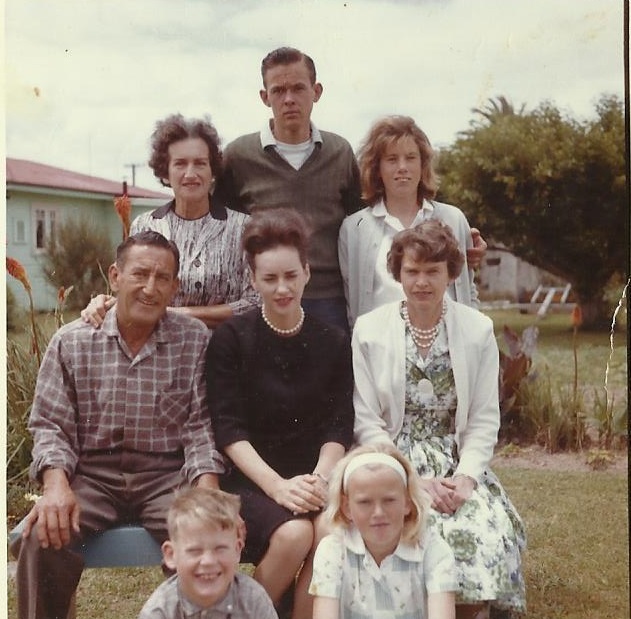
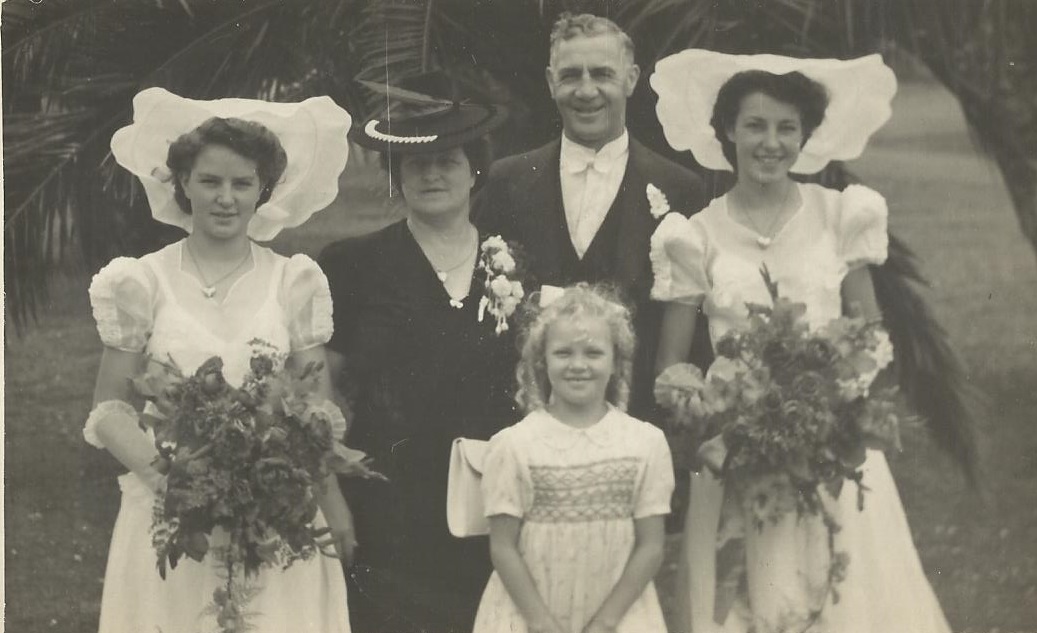
However there are three photographs which have me stumped, they were taken in the 1960’s, so potentially some people in these pictures could still be alive and I do not wish to upset or breach any privacy laws, but I do want to put names to faces.

They may even be photographs that this family may no longer have.

So can you help – the photographs are of the one family, the colour picture had written on the back “Jim Stanaway and family 1964”, the second had “Jim Stanaway and Family” and the third just had “Stanaway girls” – with may Jim’s and James’ and first and second names and the fact that some Stanaway’s just went by what ever random name they decided on (a Stanaway trait) I am stuck. (click on the picture to make larger).

Jim Stanaway and family 1964 - Barney Daniel Collection

Jim Stanaway and family 1964 – Barney Daniel Collection

Jim Stanaway and family - Barney Daniel Collection

Jim Stanaway and family – Barney Daniel Collection

Stanaway girls - Barney Daniel Collection

Stanaway girls – Barney Daniel Collection

Recent Updates as of 08/09/2015

Just letting you all know of some updates and changes on the site.

Firstly we have altered the main menu layout by reducing the number of items in the drop down menus – this mainly affects the Children and Grand children part of the site, now if you click on the Children and Grand children on the menu it will open a page which lists all the names under birth order, each name will have a link to a separate page on that person. (Note we are still working our way through all the names so some pages are only draft or have not been started).

Secondly – thanks to Colleen Stanaway we have updated Charles George Stanaway’s page – we still have work to do on his children – if anyone has any information on them please send a reply.


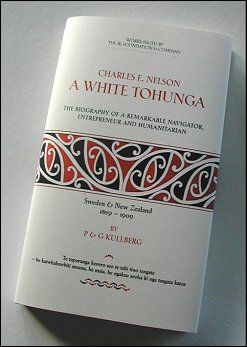
A White Tohunga – Charles E Nelson

Charles E Nelson was the husband on Isabella Stanaway, they met when Charles came up on deck as the ship he was in was being piloted through the Kaipara Harbour entry, assisting the pilot was this beautiful girl. white-tohunga

They married in 1864, Isabella was 17 and Charles 35, and settled in Helensville. Nelson Street, in Helensville is named after the family, they built the Kaipara Hotel, and had substantial land holdings in the town.

More on their life will be posted on her page, which is currently being put together.

But this post was to make you more aware of Charles Nelson and to highlight that there has been a book published on his life.

The link below will give you more information and if your are interested you can purchase a copy directly. I have a copy myself and found it very interesting.

http://www.ikfoundation.org/ikshop/white-tohunga/


Family Connections Everywhere!

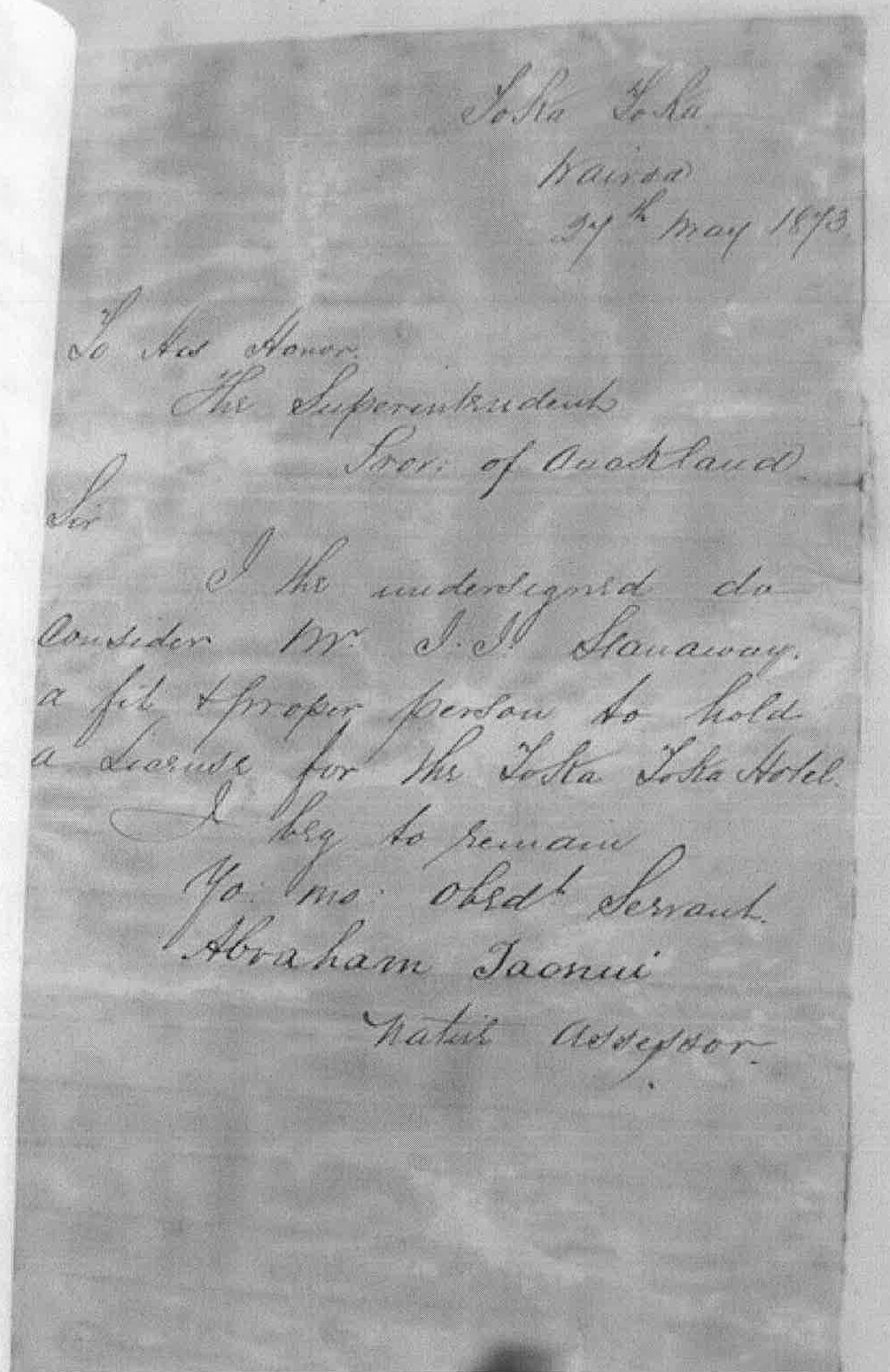
Just yesterday I received a copy of a letter dated 27 May 1873, from Colleen. This letter was written by the Native Assessor, Mr Abraham Taonui, to the Superintendent of Auckland, John Williamson, stating;

Letter 27 May 1873 from Abraham Taonui. - Colleen Stanaway Collection.

Letter 27 May 1873 from Abraham Taonui. – Colleen Stanaway Collection.

Sir – I the undersigned do consider Mr JJ Stanaway a fit and proper person to hold a licence for the Tokatoka Hotel.

Straight away we see John James mentioned as the holder of the Licence for the Tokatoka Hotel. I then saw the name of the writer – and I recognised that name, so I open my files and there it was.

It may be coincidence but it happens that Abraham Taonui (Aperahama Taonui) is the Uncle of John’s eldest son, William’s wife Susan Anderson – on her mother’s side.

From the Tera website we read the following about Abraham;

But in 1869 Aperahama left Hokianga and its intense disputes. Some thought him too deeply Christian and too sympathetic to the government. He went to live on the Wairoa River in northern Kaipara. Kinsmen from Ngati Whatua who had formerly been sheltered at Utakura by his relative, Muriwai, offered him sanctuary; subsequently, in February 1873, they gifted him 100 acres at Okapakapa and 2,061 acres at Oturei, south of Dargaville, in recognition of his role as prophet and healer. Therefore Aperahama moved from Aoroa to Oturei. He was appointed an assessor for Kaipara in 1873, but earned his living from gum-digging.

Check out more on  this link http://www.teara.govt.nz/en/biographies/2t7/taonui-aperahama

It would appear then that John would have had dealings with Abraham through gum digging also, and the Stanaway family through William’s line will go on and have more association with Abraham such as – William and Susan use the name Abraham for two of their sons, while three of their sons will be buried in the Oturei Native Cemetery.

Family Photographs

We have collected a large number of photographs, and we are thinking about posting these on another page on this site. However we first want to acknowledge the correct source/owners of these, and secondly some photographs we have are only copies of copies or photocopies etc.

We would love to obtain scanned copies of the original photographs.

7 August 1910 Ida Stanaway (Bride) married Captain Charles Bamford Daniel in the bridal party was John Stanaway (seated on right) and Johns daughter Lennise (smallest flower girl).

7 August 1910 Ida Stanaway (Bride) married Captain Charles Bamford Daniel in the bridal party was John Stanaway (seated on right) and Johns daughter Lennise (smallest flower girl).

For example there is one I am personally after as it is of my Great grandparent wedding and no one in the direct family has a copy of this (except a photocopy) – we would love to get a copy of this to go on out wall. (see attached picture).

So if you are the holder of any of the original pictures we have on this website or the ones in Tide of Times, please “leave a reply” – we would love to speak to you.

Research

For those of you who want to help/contribute to this website, I have added another page in the main menu – Research.research

Check this out – it gives a basic outline of the sort of information we are searching for, even if you may only have one or two items on the list let us know – it maybe more than what we have or it could be a link/key that could reveal a wealth of information.

At the moment we are going through some information which has been shared by one of you about Captain John James Stanaway, which is exciting and is adding more to his like story, movements, we will add this information soon.

If you have information “leave a reply” – this will give us your email address and we can follow-up with this information off-line (we will email you directly).

110 Years since the Originals

I see Lion have released a new add campaign to coincide with 110 years since the “Originals” tour of Great Britain.

Those rugby nuts amongst you may know that there was in fact a New Zealand Native tour of Great Britain before the Originals” – almost 17 years before!

One of John James Stanaway’s grand children TIKA MINARAPA (RICHARD MAYNARD) 1867 -1897, was a member of this Native team. (Check out the link).

Native Rugby Tour, 1888-89

The New Zealand Native Football Representatives’ tour of Britain is relatively unknown. The first New Zealand representative rugby team to tour beyond Australia, they played their first game in Britain on 3 October 1888. The title of ‘The Originals’ was bestowed on the next New Zealand rugby team to tour Britain, that of 1905/6, which arrived home to an official welcome befitting conquering heroes. But even though it was soon forgotten, the Natives′ tour was to have enduring significance for New Zealand rugby and society.

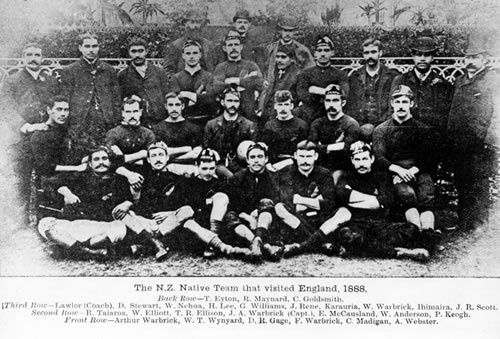
This team photo is thought to have been taken before the Middlesex match in October 1888. Back row: Thomas Eyton (co-promotor), R. Maynard, C. Goldsmith. Third row: J. Lawlor (coach), D. Stewart, W. Nehua, H.H. Lee, G.A. Williams, T. Rene, Wi Karauria, William Warbrick, E. Ihimaira, J.R. Scott (manager). Second row: R.G. Taiaroa, W. Elliott, T.R. Ellison, J.A. Warbrick (captain), E. McCausland, W. Anderson, P. Keogh. Front row: Arthur Warbrick, H.J. Wynard, D.R. Gage, F. Warbrick, C. Madigan, A. Webster.

This team photo is thought to have been taken before the Middlesex match in October 1888.
Back row: Thomas Eyton (co-promotor), R. Maynard, C. Goldsmith. Third row: J. Lawlor (coach), D. Stewart, W. Nehua, H.H. Lee, G.A. Williams, T. Rene, Wi Karauria, William Warbrick, E. Ihimaira, J.R. Scott (manager). Second row: R.G. Taiaroa, W. Elliott, T.R. Ellison, J.A. Warbrick (captain), E. McCausland, W. Anderson, P. Keogh. Front row: Arthur Warbrick, H.J. Wynard, D.R. Gage, F. Warbrick, C. Madigan, A. Webster.

The Natives had originally been called New Zealand Māori. After five Pākehā (non-Māori) were selected to strengthen the touring party it was renamed by its promoter on the basis that all 26 team members were New Zealand-born. This was untrue: two of the ring-ins had been born overseas. Most of the team assembled at a training camp near Napier in May 1888, and they played their first match against Hawke’s Bay on 23 June. Before they left New Zealand they were condemned as a ‘poor team’ who wouldn’t beat the top local club sides. But after they slipped quietly back into the country a year later, their play was praised as a ‘fine exhibition of what several months of combination and practice will do’.

By the time the Natives dispersed at Auckland in August 1889, they had played a staggering 107 rugby matches in New Zealand, Australia and Great Britain, winning 78 of them – plus nine Australian Rules and two association football fixtures! For much of that time no more than 20 of the touring party were fit, forcing those who were into a playing schedule that no modern team would contemplate.

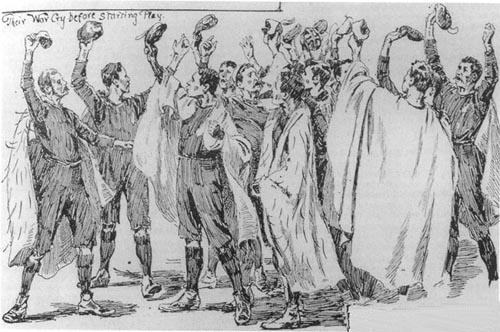
‘Their War Cry before starting play’. This cartoon of a pre-match haka by the New Zealand Natives’ rugby team was published in England during their tour of 1888/89.

‘Their War Cry before starting play’. This cartoon of a pre-match haka by the New Zealand Natives’ rugby team was published in England during their tour of 1888/89.

A major book on the Natives’ tour by historian Greg Ryan, Forerunners of the All Blacks (Canterbury University Press, 1993), provides a detailed study of the tour, and anyone interested in further information on the topic should consult this book. This excert draws extensively on Dr Ryan’s research and insights. Material from Forerunners of the All Blacks.

The average age of the tourists was about 22. Nearly all were single and had poor job prospects. An expenses-paid trip to Britain must have appealed to them.

The tour was the first from the Southern Hemisphere to visit Britain, and remains the longest in rugby’s history

Games and scores

  • Total (all codes): played 118: won 81, drew 7, lost 30
  • Total (rugby games): played 107: won 78, drew 6, lost 23 Points for: 773; Points against: 305
  • In Britain: played 74: won 49, drew 5, lost 20 Points for: 394; Points against: 188

The team cap for the New Zealand Natives’ rugby tour of 1888/89 was notable for the first use of the silver fern in New Zealand rugby. This symbol would come to be used on most New Zealand sporting uniforms.
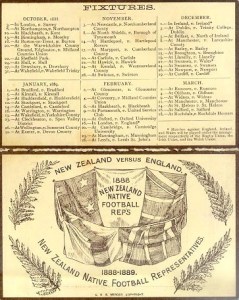
Native Tour Itinerary

Native Tour Itinerary

This entire team are now members of the World Rugby Hall of Fame.